
Backup restore test evidence for ISO 27001
A successful backup job tells you that a backup operation completed. It does not tell you that an important service can be recovered.
If you lead security at a manufacturer, that distinction matters when operations asks how long it would take to resume work. A green backup dashboard is useful, but it is not a demonstration that the application, its data and its dependencies will function together after restoration.
The information security management standard published by the International Organization for Standardization and the International Electrotechnical Commission is commonly called ISO 27001. Annex A reference A.8.13 addresses backups; A.5.30 is relevant to technology readiness for continuity. This article paraphrases the practical task rather than reproducing licensed standard text.
For useful backup restore test evidence, record what was tested, what result was expected, what actually happened and what action followed. Treat the test as a recovery check first and an audit artefact second.
What matters this week, and what can wait
This week, choose one business-critical service and agree a safe restoration scenario with its owner. Confirm that the recovery team can reach the backup, instructions and required access without relying on the very system assumed to have failed.
If a restoration test has already taken place, inspect the result. Can the service owner explain what recovered, what was not tested and what remains unresolved?
A wider exercise programme and a redesigned reporting dashboard can safely wait until this first test produces an honest result. An inaccessible backup, missing recovery knowledge or a known failed recovery path cannot. Do not wait for the next audit to address a serious operational gap.
Start with a scenario and a clear boundary
Write down the failure you are preparing for. Accidental deletion of one file is different from losing a database server or recovering after a suspected compromise.
Define the service, environment, backup set and dependencies included. The application might need identity services, configuration, encryption keys, networking, certificates and a supported software version. Identify which are part of this test and which remain assumptions.
The United Kingdom's National Cyber Security Centre recommends planning and testing restoration processes and considering data, applications, identity systems, trust infrastructure and configuration. Its technical recovery guidance also emphasises service dependencies and recovery sequencing.
Do not claim a full-service recovery if you restored only a database into an already healthy test environment. That may be a useful test with a narrow purpose. Label it accurately so management does not mistake it for a broader demonstration.
Agree success criteria before beginning
A recovery time objective is the target time to restore the required service. A recovery point objective describes the acceptable point to which data must be recoverable, usually expressed as a tolerable period of data loss. They are business targets, not results proved by a backup schedule.
The service owner should agree what successful recovery means for the scenario. The technical team should explain what the test can safely demonstrate.
| Criterion | Define before the test | Record after the test |
|---|---|---|
| Service function | Essential functions that must work | Which functions were exercised and by whom |
| Recovery time | Start point, end point and target | Actual timestamps and elapsed time on the same basis |
| Data recovery point | Required data point or tolerable loss | Backup point used and freshness of recovered records |
| Integrity and usability | Checks on completeness and meaningful use | Results, failed checks and known limits |
| Dependencies | Systems and access needed | Dependencies tested, supplied or assumed |
| Safety and containment | Approved environment and stop conditions | Deviations, stops and cleanup confirmation |
A target met under unusually favourable conditions is still only evidence for those conditions. Record whether infrastructure was prebuilt, credentials were already available and the person performing the test wrote the recovery instructions.
Prepare safely before touching the backup
Get explicit operational approval for the test plan, environment, data handling and potential service effects. This article does not authorise work on production systems.
Use an isolated, authorised environment where appropriate. Prevent restored systems from sending real customer messages, executing scheduled external actions or connecting unexpectedly to live services. Use synthetic or suitably protected data and control who can inspect it.
Keep secrets out of the test report. Record that the team could obtain required key material through the approved process, not the key material itself.
Agree stop conditions and a recovery path if the test creates instability. For operational technology, physical processes and safety-critical dependencies, involve the people responsible for safe operation before attempting changes. Do not improvise a production restoration to obtain a screenshot.
Confirm how test copies will be retained or securely removed afterwards. A forgotten restoration environment can become another source of exposed data.
Keep the test record as the work happens
Download the blank restoration test worksheet, see the fictional example, or use the workbook. No registration is needed. These are planning and evidence aids, not executable recovery instructions.
Capture the approved scenario, owner, operator, reviewer, backup reference and target criteria. During the test, record key timestamps, steps, observations and deviations. Retain protected references to logs or other records rather than copying sensitive infrastructure details into a widely shared spreadsheet.
Keep time zones explicit. State whether elapsed time begins at the simulated loss, authorisation to restore or the first technical restoration command. Changing the start point afterwards can make the report look better without making recovery faster.
Record the result of each significant check. “Restored successfully” is too broad if the application opened but the service owner could not complete an essential transaction.
A clearly fictional test result
The following example is invented practice material. It does not describe a real service, client or test. Its targets and timings are not benchmarks or suggested requirements.
A fictional scheduling service has an agreed exercise target of recovery within four hours and data recoverable to within the preceding hour. The team restores a selected backup into an isolated environment.
The application becomes available after three hours. Basic data checks pass, but a required identity dependency has been supplied by the existing test environment rather than rebuilt. The latest usable recovered records are ninety minutes older than the simulated disruption.
| Question | Honest conclusion on the invented facts |
|---|---|
| Did restoration happen? | Yes, for the defined application and dataset |
| Was the four-hour exercise target met? | For the tested boundary, with a significant dependency assumption |
| Was the one-hour data-loss target met? | No; recovered records were ninety minutes old |
| Was complete service recovery demonstrated? | No; identity recovery was not included |
| Can the action be closed? | Not until the gap and next test are assigned and reviewed |
A report that records these limits is more useful than a screenshot showing a working login screen. It gives management specific decisions: improve the recoverable data point, test the dependency and decide what interim exposure is acceptable.
Turn failures into tracked work
The test record can be accepted as suitable evidence even when the recovery outcome failed. Keep those two states separate.
Give each gap an action owner, due date and verification method. The service owner remains accountable for the recovery risk; the engineer carrying out a fix owns that particular delivery task.
Re-test the failed element after the change. If the next test is narrower, say so. Do not quietly convert a limited retest into a claim that every original criterion passed.
Use the risk-register guide to connect unresolved recovery exposure to a treatment decision. Where acceptance is proposed, obtain the authorised decision with conditions and review triggers. An overdue test is not automatically accepted risk.
Retain proof without exposing the environment
Keep source logs, result records and approval references in protected storage with an appropriate retention approach. The evidence collection guide explains how to preserve scope, provenance and review context.
A safe accompanying screenshot should show the evidence record and result using fictional or redacted content. Do not expose backup locations, internal addresses, credentials, customer records or sensitive configuration.
Keep the original internally if an external extract is redacted. A redacted report still needs enough context to show what the test covered and what it did not establish.
In GRCompliance Core, the verified public capabilities include risks, controls, linked evidence and an audit workspace. They can help organise the test record and follow-up evidence. They do not themselves restore your service or independently validate the recovery result.
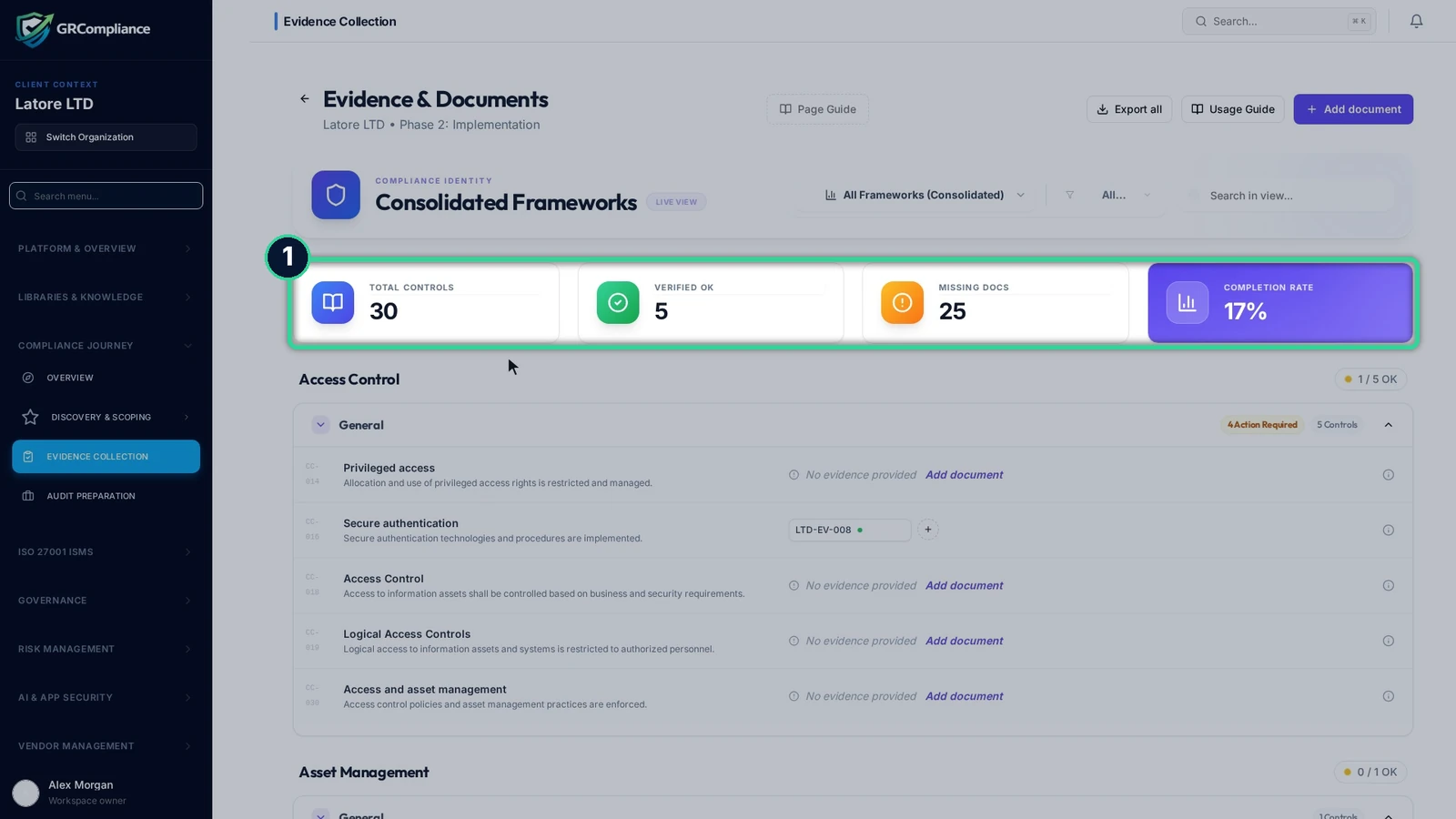
Try the live demo with fictional information only, or review the free open-source Core. This is not a tested GRCompliance backup walkthrough, and no backup integration or automatic worksheet import is claimed.
Frequently asked questions
Is a successful backup job enough for restore-test evidence?
No. It supports the backup process, but does not establish successful restoration or service recovery. Record a defined restoration scenario, checks, result and limitations.
How often should restoration be tested?
Set a justified cadence based on service criticality, change, risk and applicable requirements. Re-test relevant elements after significant changes or failures. This guide does not prescribe one interval for every service.
What if a test fails its target?
Retain the result, record the gap and assign corrective action and verification. A failed test can be valid evidence of the exercise while showing that the recovery control needs improvement.
Does the worksheet guarantee conformity or certification?
No. It is a practical aid, not an official form or a complete implementation of a standard. Software cannot make legal determinations, and neither a worksheet nor a successful test guarantees certification.
Sources
Reviewed 7 November 2026. Standard references are paraphrased; fictional exercise figures are not external statistics or recommended targets.
- International Organization for Standardization: information security management standard; Annex A references A.8.13 and A.5.30; clause 7.5 for documented information.
- Information security controls guidance overview.
- United Kingdom National Cyber Security Centre: prepare technical recovery capability: tested restoration, protected backups and infrastructure dependencies.
- GRCompliance Core documentation: controls, risks and evidence capabilities only.
Try the live demo
Open the public demo to see the product. Use fictional data only.